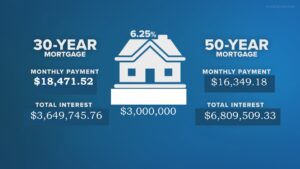
I have been a top producing realtor in the Lamorinda area for many many many years, and so, though I am not a mortgage broker, it is inevitable that people ask me what I think about the 50 year mortgage idea.
A 50-year mortgage sounds like a joke until you look at the housing market today. Prices keep outrunning wages, and young buyers are locked out like medieval peasants staring at the castle gate. So banks, regulators, and politicians are kicking around the idea of stretching mortgages to half a century as a pressure-release valve.
Pros
1. Lower Monthly Payments
This is the big one. Stretching repayment to 50 years drops your monthly payment noticeably. It doesn’t make houses cheaper. It just makes the monthly pain smaller. Buyers who are blocked at the 30-year level suddenly qualify.
2. First-Time Buyers Get Breathing Room
For younger people facing brutal rents, a lower monthly payment can be the difference between building equity and staying stuck in the renter hamster wheel. It can get people onto the ladder who otherwise would never touch it.
3. Stabilizes Demand in High-Cost Markets
Think California, Seattle, New York. Prices outpaced incomes so severely that traditional mortgages simply don’t reflect reality. A 50-year loan aligns financing with the expensive world we actually live in.
4. Encourages Mobility
Higher-interest, short-term mortgages trap people in houses. Lower payments mean relocating becomes easier. Good for the economy.
Cons
1. It Masks the Underlying Problem
Housing is too expensive because supply is broken: zoning, NIMBYism, construction bottlenecks, and land scarcity in desirable places. A 50-year mortgage papers over these issues instead of fixing them. It’s a band-aid on a gunshot wound.
2. Dramatically Higher Total Interest Paid
This is the ugly part. Over 50 years, you will pay an obscene amount of interest. Even at a modest rate, the total paid could easily double the price of the house. Buyers are exchanging short-term affordability for long-term financial burden.
3. You Build Equity Slower Than a Glacier
The amortization curve is brutal. In the first decade, your principal barely moves. If you sell early (and most people do), you walk away with crumbs.
4. Encourages Overpricing
Lower monthly payments give sellers and developers room to jack prices even higher. The very tool designed to “help affordability” often backfires by inflating the market.
5. Locks People Into Debt for Most of Their Working Life
That’s not an exaggeration. A 25-year-old buyer will still be paying it off at 75. This turns homeownership into a lifetime subscription.
Likely Effects on the Housing Market
1. Prices Will Rise
Guaranteed. As soon as lenders loosen the monthly-payment constraint, sellers adjust. We saw it with 30-year mortgages, then ARMs, then ultra-low pandemic rates. Every time financing gets easier, prices respond by climbing.
Expect at least a 5 to 15 percent uplift in high-demand areas.
2. The Entry Point Will Move, Not Expand
Politicians will brag that more people can “afford” homes. In reality, the same number of people will be competing… they’ll just be competing at a higher price range.
3. Investors Will Pounce
Lower monthly costs sweeten the math for investors and hedge funds. That’s exactly what you don’t want if you think the 50-year mortgage is supposed to help families.
4. Long-Term Risk Becomes More Concentrated
The longer the loan, the more vulnerable it is to rate shocks, inflation cycles, and borrower instability. Banks won’t feel this; they’ll package and sell the loans. But households will feel it.
5. It Becomes the New Normal
Once introduced, these loans don’t go away. They become the baseline. And in a few years, people will be begging for 60-year mortgages because the 50-year version already inflated prices beyond reach.
Bottom Line
A 50-year mortgage doesn’t solve the housing crisis. It just stretches it. It helps monthly affordability in the short term, but it worsens structural affordability over time. It turns the dream of homeownership into a longer, more expensive, more grinding commitment.
If you’re a buyer with no other way into the market, a 50-year option might be your only path. But don’t kid yourself: you’re trading future freedom for present access.
If you’re a policymaker, it’s a cheap trick.
If you’re an economist, it’s a warning sign.
If you’re a seller, congratulations. You just got a raise.
The real solution is stimulating production not demand. Encourage building, streamline permitting and environmental studies, and developing infrastructure to serve the building of new communities. Though that will trigger the NIMBY reaction.