The Federal Reserve raised its benchmark interest-rate range by a quarter of a percentage point on September 16, bringing it to 3.75%–4.00%, effective September 17. The Fed cited elevated inflation as the reason. For anyone buying or selling a home, the announcement raises questions about borrowing costs, affordability and property values. Federal Reserve announcement
Mortgage rates were already putting pressure on buyers. Bankrate’s weekly survey published September 16 reported an average 6.97% for a 30-year fixed mortgage, up from 6.76% the previous week. Individual offers vary with the borrower, loan type, points and fees. Bankrate mortgage survey
A quarter-point Fed hike does not automatically mean a quarter-point increase in mortgage rates. The Fed targets an overnight bank lending rate. Fixed mortgage rates depend more on longer-term bond markets, including Treasury yields, demand for mortgage-backed securities and expectations for inflation. Markets can also price in an expected Fed decision before it happens. The implication is that mortgage rates could rise if inflation expectations worsen, or ease if investors become more confident inflation will fall. Fannie Mae’s explanation
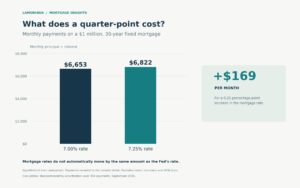
Even a modest mortgage-rate change matters when the loan is substantial. Consider these hypothetical payments on a $1 million mortgage repaid over 30 years:
| Mortgage interest rate | Monthly principal and interest |
|---|---|
| 7.00% | $6,653 |
| 7.25% | $6,822 |
That difference is approximately $169 a month. These calculations exclude property taxes, insurance, HOA dues and other ownership costs.
For the housing market, the likely consequence of sustained higher mortgage rates is weaker purchasing power. Some buyers may lower their budgets or delay a move, potentially slowing sales and increasing pressure on sellers to negotiate. However, higher rates can also discourage homeowners from listing because moving would mean replacing an inexpensive existing mortgage. Research from the Federal Housing Finance Agency shows how this “lock-in” effect can restrict supply and support prices. A slowdown in sales therefore does not guarantee falling home values. FHFA research
For Orinda, Lafayette and Moraga, the practical response is to watch local evidence: competing listings, pending sales, price reductions and time on the market. Those indicators will help show whether buyers are gaining negotiating power in a particular neighborhood and price range.
Buyers should refresh their preapproval, compare lender quotes and calculate the full monthly ownership cost. A purchase should be affordable at the rate secured today; future refinancing is an opportunity, never a certainty. Sellers should review recent comparable sales alongside current competition and be prepared to discuss price or closing-cost assistance.
If you already have a standard fixed-rate mortgage, this announcement does not change your contractual interest rate or scheduled principal-and-interest payment. Taxes and insurance can still change your total housing bill. CFPB mortgage guide
Thinking about buying or selling in Lamorinda? Let’s look at your financing, your timing and the homes competing in your part of the market.